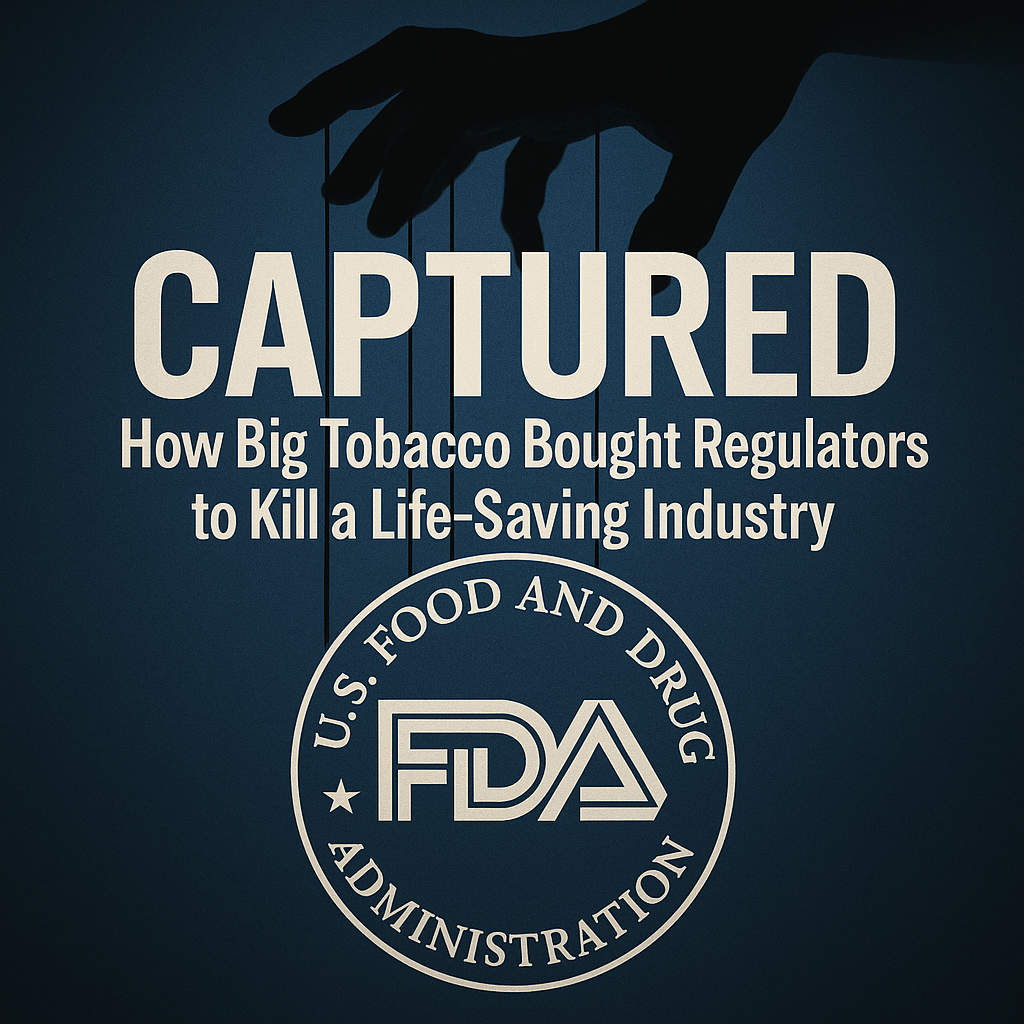
What you’re about to read is the result of a comprehensive investigation into one of the most brazen cases of regulatory capture in modern American history. Following the money, the careers, and the body count reveals a system where the agency tasked with protecting public health is entirely funded by the industry killing 480,000 Americans per year—and actively working to eliminate safer alternatives.
The evidence is documented. The conflicts are undeniable. And the stakes couldn’t be higher.
The Body Count
Cigarette smoking causes more than 480,000 deaths per year in the United States. E-cigarettes are “around 95% safer than smoked tobacco and they can help smokers to quit” [2d]. The FDA acknowledges on its own website that e-cigarettes are “generally a lower-risk alternative for cigarettes” [2e].
Yet under the current regulatory regime, “it is easier to introduce a new cigarette to the market than an e-cigarette, nicotine pouch, or heated tobacco product, all of which the agency acknowledges are safer alternatives to smoking” [6f].
This isn’t bureaucratic dysfunction. It’s not excessive caution. It’s murder by red tape—and the bodies are piling up while the profits flow in the other direction.
The Existential Threat
Follow the money, and the motive becomes crystal clear.
British American Tobacco wrote down $31.5 billion from the value of its U.S. cigarette brands, openly acknowledging that cigarettes have “no long-term future” [3c]. Altria’s CEO admitted that vapor products are “clearly the winner in the marketplace” [3a], while warning the company may not meet its 2028 sales goals “because of competition from disposable vapes” [3b].
The data confirms their worst nightmare: e-cigarettes contribute “to the decline in national cigarette consumption” [3d]. Every person who switches from smoking to vaping is a customer Big Tobacco loses. Forever.
This is an extinction-level event for their business model. And they will do anything—pay anyone, capture any agency, write any law—to survive.
The Funding Mechanism
The FDA’s Center for Tobacco Products operates on a funding model that would make any ethics watchdog blanch: it is “fully funded” by Big Tobacco [5a]. Not partially funded. Not subsidized. Entirely funded by the very industry selling combustible cigarettes—fees collected from traditional tobacco companies rather than e-cigarette manufacturers [5b].
Read that again. The agency tasked with regulating tobacco products is paid exclusively by the companies that profit from cigarette sales.
This creates a perverse incentive to restrict safer e-cigarette alternatives while preserving the market for the combustible cigarettes that actually fund the agency’s operations [5b]. Every time someone switches from cigarettes to vaping, the FDA’s budget takes a hit.
The conflict of interest isn’t theoretical. It’s structural. It’s baked into the balance sheet.
The Revolving Door
Matthew Holman spent years as Director of the Office of Science at FDA’s Center for Tobacco Products. He knew the agency’s inner workings, its standards, its pressure points. Then, suddenly, he quit [5c].
His new employer? Philip Morris.
Before leaving, Holman had overseen approval of Philip Morris’s IQOS heated tobacco product as a “modified risk” device—despite evidence showing it “contained toxins… at higher levels than in combustible cigarettes” [5c]. Mission accomplished, presumably.
He wasn’t alone. Roxana Weil, former Lead Toxicologist at FDA CTP, joined Altria’s Juul just as the company faced regulatory scrutiny [5d]. Perham Gorji, a senior FDA tobacco lawyer who worked on menthol regulations, left the agency and immediately joined DLA Piper—Philip Morris’s law firm [5e]. The FDA later withdrew its proposed menthol ban [5g].
The pattern is unmistakable: FDA officials shape tobacco policy, then cash out to represent the industry they were regulating. They know where the bodies are buried because they helped dig the graves.
The State-by-State Play
Unable to stop vaping’s rise through federal action alone, Big Tobacco went local—and they stopped pretending to hide it.
Altria openly lobbied for vape registry laws in Kentucky and “worked with legislatures in a number of states” to ban flavored vapor products [4a]. “At least two of these manufacturers – Altria and R.J. Reynolds – have been actively lobbying legislators in various states to adopt such laws and some 10 other states have enacted similar measures” [4b].
But Wyoming’s SF0107 hearing on March 4, 2024, exposed just how brazenly the fix was in [4d].
Chairman Olsen opened by limiting public testimony to one minute per person, alternating strictly between supporters and opponents. Then Representative Landon Brown—the bill’s primary sponsor and Chairman of the Wyoming Joint Education Committee—took the floor to introduce his own legislation.
And immediately handed the microphone to Altria.
Not to one lobbyist. To two. David Picard, a registered Altria lobbyist, and David Sylvia, Altria’s Senior Director of Public Policy, presented the vape registry bill while the elected official who sponsored it watched [4d]. Under Chairman Olsen’s alternating-speaker rule, those two industry presentations consumed the speaking time that would have gone to two citizens opposing the bill.
A state legislator literally ceded his constitutional authority to corporate lobbyists, who then used procedural rules to silence opposition.
The Public Health Law Center saw through the charade: “Big Tobacco has profit-driven incentives behind their [lobbying efforts]: the registry laws keep competitors out of the marketplace” [4c].
Read that again. The companies selling cigarettes are lobbying to restrict access to the products that help people quit cigarettes. And elected officials are letting tobacco executives write and present the laws under their own names.
The Rigged Approval Process
The federal execution of this strategy was even more surgical.
Nearly 26 million e-cigarette products were submitted to the FDA’s Premarket Tobacco Application process [6b]. How many were approved?
Thirty-nine [6c].
All owned by Big Tobacco companies [6c].
The FDA “failed to design a uniform application process,” by its own admission [6a]. In August 2021, the agency suddenly announced it would deny about 55,000 applications for flavored products and demand robust studies—like randomized control trials—that it had never previously required [6d]. When smaller manufacturers asked for time to conduct these surprise studies, the FDA refused and denied their applications [6d].
Meanwhile, NJOY’s lawsuit revealed that the FDA denied the company’s flavored e-cigarettes despite the agency’s own internal reviews—revealed through FOIA—confirming NJOY “adequately addressed youth concerns and showed superior smoking cessation rates” [6e].
The U.S. Office of Special Counsel investigated the FDA’s tobacco review process and found the agency “relaxed its standards of review for certain tobacco products and stifled attempts by its scientists to raise concerns” [5h].
Scientists were silenced. Standards were bent. And always in the same direction—toward Big Tobacco products and away from their competitors.
The FDA allowed Philip Morris to market IQOS with “reduced-exposure” claims despite evidence showing increased exposure to other toxins [5i]. The FDA’s advisory committee concluded that “removal of menthol would benefit public health” [5f]—giving the agency exactly what it needed to ban menthol cigarettes. They sat on that information for 10 years before actually proposing a rule, then withdrew the proposal earlier this year [5g].
The Truth About Bans
When Massachusetts and California restricted flavored vaping products, researchers documented what happened next—and it was exactly what you’d expect when you take away a safer alternative.
Flavor restrictions “increased cigarette use among youths and young adults” [7a]. E-cigarette flavor restrictions in place for a year or longer yielded “20% increases in sales of cigarette brands disproportionately used by underage smokers” [7c].
A 2015 study found that “reducing e-cigarette access increases smoking among 12 to 17 year olds” [7d]. Participants in a 2021 study were “more likely to purchase from the [illegal market] when product availability in the [legal market] was more restricted, with e-cigarette users being most affected” [7b].
The policy intended to protect youth instead pushed them toward deadlier products—both legal cigarettes and black market vapes. The “for the children” rhetoric produced child smokers.
The Manufactured Youth Crisis
The entire regulatory crackdown hinges on claims of epidemic youth vaping. There’s just one problem: youth e-cigarette use just dropped to its lowest level in a decade [1a].
Usage decreased from 2.13 million youth in 2023 to 1.63 million in 2024 [1a]—a dramatic 23% decline. Youth vaping peaked in 2019 at 20.1% [1c]. Today it sits at 5.9% [1a].
Meanwhile, 17% of high school students used marijuana in the past 30 days [1e], and 11.2% of adolescents aged 12-17 use marijuana [1d]. Youth marijuana use is nearly three times higher than vaping.
Yet there’s no federal panic about cannabis. No billion-dollar enforcement campaign. Many states have legalized it—and the federal government does nothing, despite marijuana remaining federally illegal. In legal states, dispensaries require ID checks, security guards, and controlled-access back rooms. Actual restrictions that work.
Compare that to vaping products sold at gas stations.
If youth protection were the priority, why does the product with three times the youth usage get state flexibility while the safer product faces federal annihilation?
Because there’s no Big Marijuana company funding a regulatory agency. No revolving door. No captured budget.
And here’s the kicker: among adolescents who do vape, 66% use e-cigarettes without nicotine [1b]. Two-thirds of youth vapers aren’t even using nicotine.
The youth crisis was manufactured to justify regulatory capture. The comparison to marijuana exposes the lie.
The Verdict
This isn’t incompetence. It’s not bureaucratic dysfunction. It’s not excessive caution in the face of uncertainty.
It’s regulatory capture, pure and simple.
An agency funded entirely by cigarette companies has:
- Approved only Big Tobacco vaping products [6c]
- Denied hundreds of thousands of applications from competitors [6b]
- Changed approval standards mid-process to deny smaller manufacturers [6d]
- Employed officials who then went to work for the industry [5c][5d][5e]
- Ignored its own scientists’ concerns [5h]
- Pushed policies that increase youth smoking [7a][7c][7d]
- Dismissed evidence that vaping is 95% safer than smoking [2d]
All while cigarette companies openly lobby for vaping restrictions [4a][4b] and acknowledge their own products have “no long-term future” [3c].
The science is clear: “E-cigarette consumption is less toxic than tobacco smoking” [2a]. “E-cigarettes exhibit reduced exposure to harmful toxins compared to traditional cigarettes” [2b]. Long-term e-cigarette use shows “substantially reduced levels of measured carcinogens and toxins relative to smoking only combustible cigarettes” [2c].
If vaping is 95% safer and helps smokers quit, restricting access to vaping products isn’t protecting public health.
It’s protecting cigarette sales.
And the body count speaks for itself.
Sources
1. Youth Smoking / Vaping / Marijuana Trends
-
Youth e-cigarette use drops to lowest level in a decade
-
FDA (2025),
press announcement
- “Decrease from 2.13 million (7.7%) youth in 2023 to 1.63 million (5.9%) youth in 2024.”
-
FDA (2025),
press announcement
-
Adolescents’ Use of Nicotine-Free and Nicotine E-Cigarettes: A Longitudinal Study
-
Tokle et al. (2021),
PMC8842395
- “Among adolescents reporting vaping… 66% had used e-cigarettes without nicotine.”
-
Tokle et al. (2021),
PMC8842395
-
Tobacco Product Use and Associated Factors Among Middle and High School Students — United States, 2019
-
Wang et al. (2019),
CDC MMWR
- Youth tobacco product use peaked in 2019 at 20.1%.
-
Wang et al. (2019),
CDC MMWR
-
Highlights for the 2023 National Survey on Drug Use and Health
-
SAMHSA (2023),
NSDUH highlights (PDF)
- 11.2% of adolescents aged 12–17 used marijuana (past year).
-
SAMHSA (2023),
NSDUH highlights (PDF)
-
Youth Risk Behavior Survey (YRBS)
-
CDC (2023),
2023 Data Summary & Trends
- “In 2023, 17% of high school students used marijuana during the past 30 days.”
-
CDC (2023),
2023 Data Summary & Trends
2. Harm Reduction and Toxicology Evidence
-
An updated overview of e-cigarette impact on human health
-
Marques et al. (2021),
Respiratory Research
- “E-cigarette consumption is less toxic than tobacco smoking.”
-
Marques et al. (2021),
Respiratory Research
-
Comparative systematic review on the safety of e-cigarettes and conventional cigarettes
-
Yayan et al. (2024),
PubMed
- Reduced exposure to harmful toxins compared with smoking.
-
Yayan et al. (2024),
PubMed
-
Nicotine, Carcinogen, and Toxin Exposure in Long-Term E-Cigarette and NRT Users
-
Shahab et al. (2017),
Annals of Internal Medicine
- Substantially reduced carcinogens and toxins vs smokers.
-
Shahab et al. (2017),
Annals of Internal Medicine
-
E-cigarettes: an evidence update
-
United Kingdom (2015),
Public Health England
- “E-cigarettes are around 95% safer than smoked tobacco and they can help smokers to quit.”
-
United Kingdom (2015),
Public Health England
-
E-Cigarettes, Vapes, and other ENDS
-
FDA (2025),
ENDS overview
- E-cigarettes are generally a lower-risk alternative to cigarettes.
-
FDA (2025),
ENDS overview
3. Big Tobacco Market Threat / Economic Motive
-
Earnings call transcript: Altria Q4 2024
-
Investing.com (2025),
Transcript
- “Vapor products are clearly the winner.” — Altria CEO.
-
Investing.com (2025),
Transcript
-
Altria “smoke-free” targets under threat from illicit vapes
- Reuters (2025), Report
-
BAT writes down $31.5B on U.S. cigarette brands
-
Reuters (2023),
Report
- Company says cigarettes have “no long-term future.”
-
Reuters (2023),
Report
-
Sales of ENDS and Cigarette Sales in the USA: A Trend Break Analysis
-
Selya et al. (2023),
Open access
- ENDS contribute to decline in national cigarette consumption.
-
Selya et al. (2023),
Open access
4. State-Level Lobbying / Vape Registry Laws / Model Authorship
-
New restrictions on vape sales in Kentucky win approval with tobacco-industry backing
-
Kentucky Lantern (2024),
Article
- Altria lobbied for a vape registry in Kentucky.
- Altria worked with legislatures in multiple states to ban flavored vapor products.
-
Kentucky Lantern (2024),
Article
-
Vapes, Big Tobacco and a new Mississippi registry law
-
Magnolia Tribune (2025),
Article
- Altria and RJR actively lobbying; ~10 other states enacted similar measures.
-
Magnolia Tribune (2025),
Article
-
State E-Cigarette Registry Bills and What to Make of Them
-
Public Health Law Center (2024),
Commentary
- “Registry laws keep competitors out of the marketplace.”
-
Public Health Law Center (2024),
Commentary
-
Wyoming Legislature — SF0107 Committee Video
- House Corporations, Elections & Political Subdivisions (Mar 4, 2024), video
5. FDA-Industry Collusion / Revolving Door Evidence
-
The Food and Drug Administration Is Not Positioned to Deter Adolescent E-Cigarette Use
-
Rodu (2020),
Open access
- CTP “fully funded” by Big Tobacco.
-
Rodu (2020),
Open access
-
FDA should re-examine incentives to collect tobacco user fees fairly
-
American Consumer Institute (2023),
Report
- Funding structure creates perverse incentives that disadvantage ENDS.
-
American Consumer Institute (2023),
Report
-
A top FDA tobacco expert suddenly quits — to work for Big Tobacco
-
JD Supra (2022),
Article
- Matthew Holman, former CTP Office of Science Director, joined PMI; IQOS got reduced-exposure order despite toxin issues.
-
JD Supra (2022),
Article
-
Juul bulks up its science staff as FDA vaping deadline nears
-
Los Angeles Times (2020),
Article
- Former FDA toxicologist joined JUUL.
-
Los Angeles Times (2020),
Article
-
Former FDA lawyers join tobacco industry in ‘epic’ fight against the agency
- The Examination (2024), Investigation
-
TPSAC gave the FDA what it needs to ban menthol
- UCSF (2011), Post
-
Proposed Menthol Rules Withdrawn: Litigation Continues
- Public Health Law Center (2025), Update
-
Unclear Standards for Scientific Review and Stifling of Scientific Dissent…
- U.S. Office of Special Counsel (2022), Statement
-
FDA’s reduced exposure marketing order for IQOS: why it is not a reliable global model
- Lempert et al. (2021), PubMed
6. FDA Failings
-
Update on the FDA Premarket Review Process
-
Public Health Law Center (2021),
Commentary
- FDA failed to design a uniform application process.
-
Public Health Law Center (2021),
Commentary
-
FDA makes determinations on more than 99% of 26M tobacco products
- FDA (2023), CTP Newsroom
-
ENDS authorized by the FDA
-
FDA (2025),
Authorized ENDS list
- Only 39 authorized; all owned by Big Tobacco.
-
FDA (2025),
Authorized ENDS list
-
FDA v. Wages and White Lion Investments, L.L.C. (White Lion)
-
Cornell LII (2025),
Docket
- Aug 26, 2021: FDA denied ~55,000 flavored PMTAs; demanded RCT-level evidence without prior consistent guidance; later denied White Lion’s request to conduct studies.
-
Cornell LII (2025),
Docket
-
NJOY sues FDA over delayed ruling on flavored disposable vapes
- Complaint (2025), PDF
-
Hearing wrap-up: FDA must eliminate red tape…
-
U.S. House Oversight Committee (2025),
Release
- “It is easier to introduce a new cigarette than an e-cigarette or nicotine pouch.”
-
U.S. House Oversight Committee (2025),
Release
7. Smoking Increases Caused by Flavor Bans
-
State E-Cigarette Flavor Restrictions and Tobacco Product Use in Youths and Adults
-
Cheng et al. (2025),
JAMA Network Open
- “Flavor [restrictions]… increased cigarette use among youths and young adults.”
-
Cheng et al. (2025),
JAMA Network Open
-
The Illegal Experimental Tobacco Marketplace I: Effects of Vaping Product Bans
-
Freitas-Lemos et al. (2021),
Open access
- Participants more likely to purchase from the illegal market when the legal market was more restricted; e-cig users most affected.
-
Freitas-Lemos et al. (2021),
Open access
-
Tobacco purchases rise following restrictions on e-cigarette sales
-
Yale School of Public Health (2023),
News
- Flavor restrictions ≥1 year yielded ~20% increases in cigarette sales in brands disproportionately used by underage smokers.
-
Yale School of Public Health (2023),
News
-
How does electronic cigarette access affect adolescent smoking?
-
Friedman (2015),
Health Economics
- “Reducing e-cigarette access increases smoking among 12 to 17 year olds.”
-
Friedman (2015),
Health Economics
Leave a Reply